
Commitments
Tiny Planets is a committed company whose objectives are not solely – or even primarily – economic. The meaning of our adventure lies in the vision that guides us, the values we uphold and the commitments we implement on a daily basis.
Ecology
We firmly believe that changing our mindsets must go hand in hand with transforming our practices. We support projects that aim to better understand our impact and guide the industry towards more sustainable methods of creation, based on sharing and pooling resources.
Okawari - World premiere at the 2022 Venice Biennale
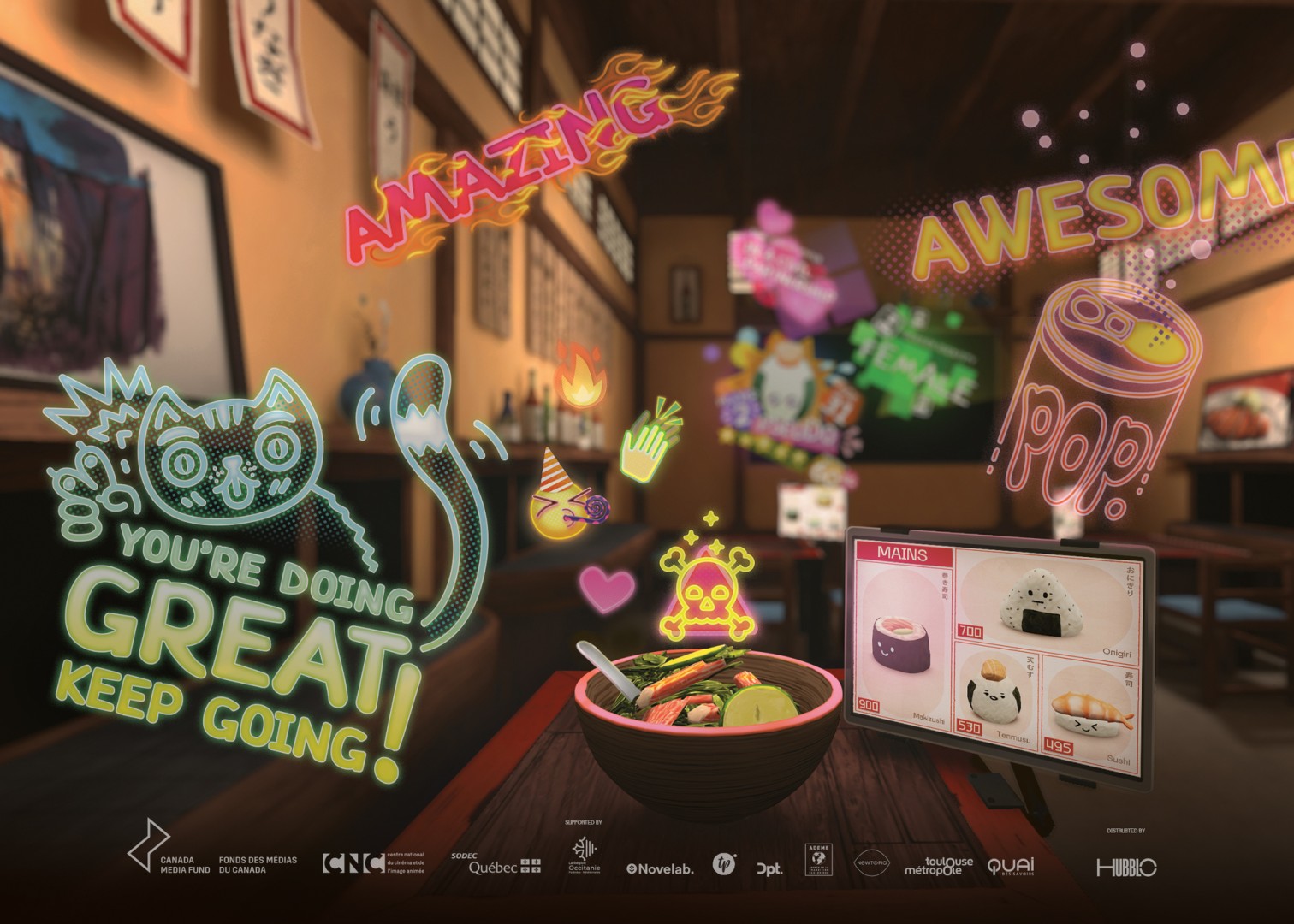 Presented in competition at the Venice Biennale 2022, Okawari is a pioneering immersive work in terms of eco-design: upcycling of 3D assets, low-carbon travel, no air travel, as part of a France-Canada co-production, etc.
It is also the first immersive creation to have calculated and displayed its carbon footprint, updated in real time during each presentation, covering its entire life cycle - including distribution.
The aim was to use an interactive immersive work with a strong message to highlight the environmental impacts of its creation, production and distribution, in order to raise awareness among both the public and the immersive industry.
CEPIR - Case Study for Responsible Immersion (France 2030 laureate)
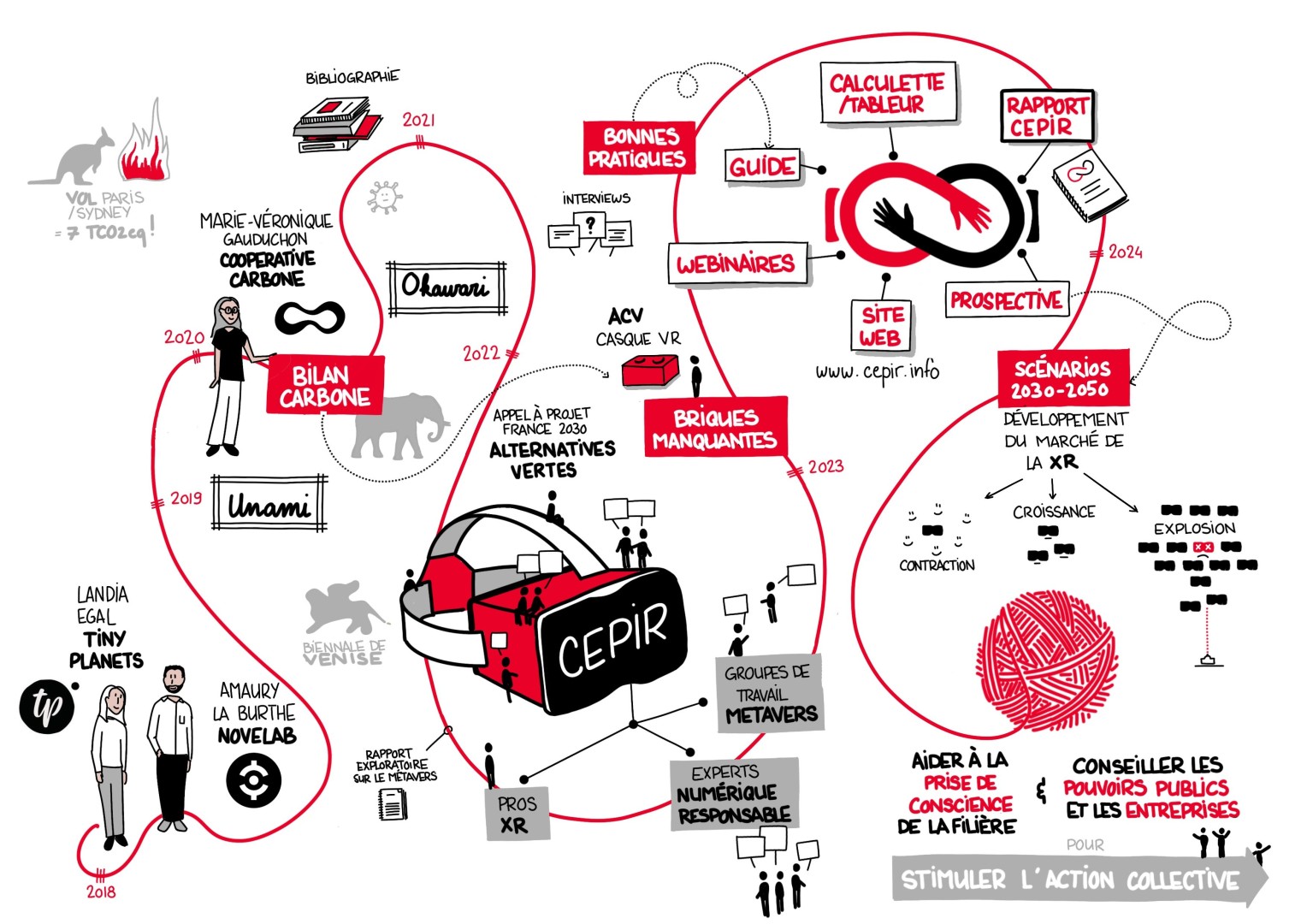 CEPIR est un projet d’évaluation des impacts environnementaux de la filière XR franCEPIR is a project to assess the environmental impact of the French XR sector, supported by the government as part of the ‘Green Alternatives 1’ initiative (France 2030).
All results, tools and resources, published in February 2024, are freely available on the official website : CEPIR.
Based on the observation that the immersive industry lacked data and tools to measure its environmental impact, we brought together immersive creation stakeholders, researchers and responsible digital experts to:
- create new emission factors for virtual reality headsets (previously non-existent);
- develop an open-source carbon calculator tailored to immersive structures and projects;
- draft a best practice guide for more sustainable and energy-efficient designs;
- explore the future of the sector by 2030 through a forward-looking analysis based on five scenarios, which we then compared with national decarbonisation trajectories;
- formulate operational recommendations for public authorities and professionals to support the sector's transition.
SATIR - Système des Arts Technologiques Immersifs et Responsables
Faced with the need to align immersive practices with national environmental impact reduction trajectories, the difficulties cultural institutions have in designing sustainable experiences based on their existing equipment, and the lack of commons facilitating pooling and reuse, SATIR aims to provide a structured response.SATIR is presented as an open-source technological commons, comprising:
- a digital platform;
- a library of simple and modular technological building blocks;
- experience templates designed to support cultural institutions and their partners in creating more sustainable and immersive interactive experiences.
SATIR aims to become a benchmark for the sector: a driver of sustainability, a tool for cultural sovereignty and a European model for responsible immersive creation, based on sharing, interoperability and innovation for the common good.
Awareness raising
Throughout the year, we raise awareness among the general public and professionals about environmental issues through a variety of one-off and ongoing initiatives:
- coordination of the New Narratives group of the Les Shifters association;
- participation in several national commissions (CNC, France 2030);
- participation in working groups, notably the Shift Project's Digital Experts group;
- commitment as an active member of Ecoprod since its inception;
- participation in conferences and round tables on topics related to immersive creation, new narratives and environmental impacts in the cultural and digital sectors;
- one-off contributions to training courses (e.g. Augures Lab Numérique Responsable, universities, etc.).
Equality and governance
Because a healthy and sustainable business relies on fair organisation, we are committed to implementing and maintaining internal practices guided by equity and sharing.
Gender balance
Since Tiny Planets was founded, we have been committed to promoting gender balance, both in our recruitment and in the composition of our shareholding structure. More broadly, we strive to ensure that the talent involved in our projects reflects a diversity of profiles and perspectives.Gender balance
Reducing internal pay gaps
Salaries are equivalent for all people in the same position, to avoid any discrimination based on age, gender or seniority, and we limit pay gaps within the team as much as possible.
Governance
To prevent inequalities among decision-makers, all partners have the same voting rights, regardless of their share in the capital: one partner = one vote. We also ensure that important decisions are presented, monitored and discussed collectively, in order to involve stakeholders and ensure clear and consistent operations for all.